Showing posts with label Facebook. Show all posts

18 April, 2011

Intern Sweatshop: How Do You Using Social Media?

I remember when I thought that Facebook was pointless. I had the idea it was only used for people who were in college, and I wasn’t in school so I didn’t see a reason to sign up. People convinced me to check it out, and told me that more than just students were using it. Now my mother posts more on Facebook than I do.

The point is that everyone is using social media today, and it is used for more than just telling people what is on your mind. Social media can be used for many different reasons including locating people, gathering information, advertising, as a resume of sorts, but most importantly as a tool to connect with other people.

Think of what happened in Egypt as a prime example. A Google executive Wael Ghonim started a Facebook page that called for protests on January 25th, which is now known as the “Day of Wrath.” He called for the protests in response to the violent beating death of an Egyptian businessman, who was beaten to death after he planned on exposing corruption in the government. The page was named after the man who died, and was called “We are all Khaled Said.” Ghonim was arrested on January 28th and was released twelve days later. The rest is history.

I remember following a New York Times list on Twitter that posted people live in Tahrir Square as the news Mubarak had stepped down. One woman posted that she couldn’t stop laughing and crying at the same time, and I could follow Egyptian’s reactions as they were happening in real-time. It was so moving that I almost cried myself.

Ghonim used social media to broadcast his message, and gather people to form a revolution. This has spawned many other similar events in the Middle East such as Libya, Bahrain, and Yemen; and others are just now beginning to quell into a true social movement for change.

Social media allows for someone to get a message out quickly, and to a large number of people. Word spreads quickly on Facebook and Twitter, and news is almost instantaneous. With the recent earthquake and tsunami in Japan the news of the event came from social media first, with the actual news second going so far as to cite what they were seeing on Twitter as sources.

What do you think it would have been like on 9/11 if Facebook and Twitter were around then, and were used in the capacity that they are today? It could have been much easier for people to find out if their loved ones were okay via social media avenues. Imagine if social media was around during the times of the Titanic?

It is clear that social media is changing the way that information is disseminated. The news that Michael Jackson died shut down Twitter for a short period of time. This is an example of how often today people get their news from social media and from their friends. Who better to trust than your friends on social media?
Advertising has been changed tremendously and most companies now have social media sites. Even so, some companies have yet to utilize this avenue effectively for marketing purposes, they are left trying to answe the question: How does a Facebook page actually translate to sales?


The bottom line is that social media has an enormous impact on how societies today communicate with each other. If Facebook were a country, it would be the third largest in the world, and it is continuing to grow. It has become an avenue for unprecedented open communication. I think we have just now tipped the iceberg for how it will be used in the future. The question is… how do you use social media?

Robert Devereux , Account Executive Intern/Inquisitive Soul

Last Heard on the Intern Sweatshop: Apparently Our Custmers Like Our Crappy Commercials

Read more...
Intern Sweatshop: How Do You Using Social Media?SocialTwist Tell-a-Friend

19 November, 2010

Conan: Successful Social Media User

How does an ex-talk show host who has a very public spat with his old network for trying to change his timeslot, rebound after a do-not-appear-on-tv buyout deal, and end up at the top of the ratings?


The Answer: Social Media

Since his falling out with NBC in 2009, Conan was prohibited from appearing on television. Without his familiar zaniness outlet, Conan turned to one of the only places left for him to connect with his audience, a Twitter account.
This was literally the first fans would hear from Conan since the gag order.

Conan continually fed the masses of hungry fans who were bitter with NBC and Jay Leno for not supporting their uniquely-haired talk show host, bringing the #TeamCoco movement to a fever pitch.

Filling a stream with personal anecdotes and making headlines by following just one random Twitter user, Conan had tapped into the pulse of what drove his show, and in essence, himself to be such big hits.

Soon after, Conan also put on a brief 30-city tour, appropriately named "The Legally Prohibited From Being Funny on Television Tour, which featured such acts as Conan and Jim Carrey dressed as Kick Ass and Superman performing Five for Fightings' "Superman (It's Not Easy.)"


Around this time he launched the appropriately named TEAMCOCO, which became the nexus for all things Conan including a special announcement in September that he would be launching a new show on TBS in November.

He followed this up with a Facebook where he would randomly take a Facebook fan's question and answer them on his Youtube channel.

After that it's a whirlwind of a live 24-hour webcam event, a mock first show called Show Zero, and of course the Team Coco blimp which featured it's own Foursquare badge if you were lucky enough for it to float over your city.

Conan O'Brien's social media experience illustrates one of the most successful uses of social marketing by a celebrity in connecting with their audience.

He had interactions and influence numbers that marketers drool over.

And what was the result of all of these social shenaningans?

When Conan's show finally premiered on TBS, the audience he had gained through his career at Late Night with Conan O'Brien and the Tonight show, the audience he had gained through Dancing Tacos, I Miss Conan videos, and exclusive Foursquare badges tuned in and put him on the ratings throne of late night television.

With his attention back toward his TV show, will the stream of content be hindered so much so that Team Coco's social presense dwindles? Or was this all merely a stop gap until he made it back to the airwaves?

Sean Sutherland, Associate Account Executive/Team Coco supporter

Read more...
Conan: Successful Social Media UserSocialTwist Tell-a-Friend

13 October, 2010

Crowdsource This Blog Post

So this happened and started the ball rollin'.


A helvetica-fonted brand name running into a gradient-shaded blue square.

Ugh.

And after the dust settled, and everyone and their grandma weighed in about how they felt that the new logo was so terrible, speculation began: was it a farce?

Then this happened. The President of Gap, Marka Hansen posted on Huffington Post, dispelling the rumors, sticking up for Laird and Partner's efforts, and playing the role of peacemaker.

At the same time this went live on Facebook. Through all the threats of calls to the AIGA and talk of boycotting, a few groups (them and them) actually stepped up and starting posting designer ideas.

Then, with the threat of the brand losing it's identity through "crowdsourcing", this happened.

Gap fell, like all the other Goliaths to the Davids and their combined slingshots of hate, and returned to using the good ol' blue box.
One question remains, however.

Could this have all just been a publicity stunt?

Harking on the theme I brought up in my first Confessional post, curving the dialogue around the creation of a replacement ugly logo, Gap insured that they would be the on the tip of everyone's tongues.

Could Gap not have been satisfied by the social media bump they experienced after the Groupon spectacle that they had to one-up themselves with this logo fiasco?

If it was just a publicity stunt, it's unclear if this will pay off.

From what I've seen, there's a seething anger coming from designers and consumers alike, calling for boycotts of Gap and claims of being unethical.

Regardless of what it truly was, we'll see how this hurt/helped Gap in the coming months.

Do you think this was some publicity stunt or just another example of the mishandling of a social marketing initiative?

Shout outs to @GapLogo, @OldGapLogo, craplogo.me, and the dozens of other new media machinations created during the brouhaha.


Sean Sutherland, Associate Account Executive/Crowdsorcerer

Previously in logo-speak: Logo Fail of Olympic Proportions; Logolicious.


Read more...
Crowdsource This Blog PostSocialTwist Tell-a-Friend

09 May, 2010

T4: Rise of the Facebook

Ryan Singel of Wired tears Facebook a new one for its continually decaying privacy policies. Pretty enlightening. Now I'm not as plugged in as most facebook users. I may goes days without checking. I generally use facebook to read random/witty things said by friends/family/people I haven't seen since 4th grade, as opposed to informing people about what TV show I'm watching or providing daily updates about my farm. And actually, I'm not sure I've ever "liked" anything. Instead, I just comment when I like a post.


But it makes me wonder if a facebook backlash will lead to the next big social networking site. If you remember, MySpace was the number one social networking site for about two years, until Facebook knocked it off just over two years ago. And 10 years ago, who would've thought people would use any search engine but Yahoo. Be careful, Facebook, we may just send our XO Creative Director after you.

Any suggestions on where I should take my social networking instead? I hear Google would like my assistance in taking over the world as well.

Read more...
T4: Rise of the FacebookSocialTwist Tell-a-Friend

12 April, 2010

Intern Sweatshop: Has Social Media Gone Too Far?

Facebook, Twitter, MySpace… just to name a few. Social media is great, right? Catch up with old friends, see how everyone’s doing, and even advertise for your company. But as the saying goes, it’s all fun and games until someone gets hurt.

Have you heard of the newly popular foursquare? No, not the playground game – the social networking site. You download an application onto your cell phone, and then as you go places, you “check in” on foursquare. You are then awarded “points” and “badges” for updating your location. So, it’s an application that encourages you to explore different locations and let friends know what you’re doing. No harm in that, right?

Wrong. Consider this scenario: You go out with some friends to your favorite restaurant, and you check in via foursquare, “in New York, NY: White Castle has the best burgers!” Guess where everyone now knows you’re at… you guessed it, the White Castle in New York, NY. But what’s more important, guess where people now know you're not: your home.

foursquare seems to have just gone a bit too far. I’m sure the creators had no intention of making this dangerous, but this can cause problems with stalking because people know your location, as well as theft because people know when you aren’t home. The website pleaserobme.com was created to raise awareness about “over-sharing.” It scanned tweets from twitter and check-ins from foursquare and posted them on their website to show people who were not in their home. Recently, the site has stopped showing the tweets or check-ins but still encourages people to not share anything they don’t want everyone to know.

This link shows you how a guy figured out a woman’s age, location, profession, shopping habits, email address, and phone number in a matter of minutes from social networking sites. Quite scary to know how much someone can find out about you just by a few clicks of the mouse. Here's another link to an article about a woman who claimed to have been robbed after posting on Facebook that she would be out for the evening.

So, while social media may seem like a great thing, just be careful what you do and what you say. Whether it's a Facebook post a potential boss may find or a foursquare check-in a potential stalker may look at, once it's on the Web, it's hard to take it back.

--Tara Cammarata, Creative Department Stealth Intern

Last time on the Intern Sweatshop: Is Dove Men+Care really targeting men?

Read more...
Intern Sweatshop: Has Social Media Gone Too Far?SocialTwist Tell-a-Friend

30 March, 2010

The most comprehensive infographic on Facebook ever...until next week.

Kind of humbling to think that in the time it took me to finally get around to replacing the light bulb in my refrigerator, Facebook grew from 12 million users to over 400 million.

Did I say humbling? I meant humiliating.

Infographic from Website Monitoring Blog via these guys.

(Click it to go big. Or go home.)


Previous Facebookedness: I hate Facebook's stupid face; Filchbook.

Read more...
The most comprehensive infographic on Facebook ever...until next week.SocialTwist Tell-a-Friend

24 March, 2009

I hate Facebook's stupid face. Or do I?

Great article in Slate pointing out what H.L. Mencken always knew: the masses are easily cajoled into liking whatever the Illuminati/Politicati/Economati tell them to. It just takes time. Admit it or not, even the most liberal Web 2.0 evangelist is nothing more than a crotchety old man shaking his cane at the neighborhood kids from his lawn chair.


We hate change. We like things comfortable. We like things easy.

But, over time, we'll adjust. Hell, we adapted to the crappy, discombobulated Facebook interfaces of olde. And we'll adapt to this one. And this time, it'll be even easier seeing as how Facebook stole everything but the whale from Twitter.

We'll accept this version of Facebook. And the next one. And the next one.

Carry on, fellow social media succubuses.

Read more...
I hate Facebook's stupid face. Or do I?SocialTwist Tell-a-Friend

13 March, 2009

Friday Ad Haiku: Filchbook

You know you're on to something when Facebook wunderkind Mark Zuckerburg pilfers what makes your utility great. Twitter, as if it needed the validation, was obviously the primary inspiration for Facebook's face lift - namely the addition of a real-time friend stream and a reworking of the status window.

(Click pic=big pic)

Personally, I'm not impressed. Using Facebook is the social network equivalent of unhooking a bra on prom night: full of good stuff, but way more complicated than it should be. A parade of sketchy apps and pokes and super pokes and ultra-craptomic pokes. Sure, I still use it frequently, but it's more in spite of all the moving parts, not because of them. Unfortunately, every step Facebook takes to be more like Twitter gets it that much further from what makes it unique.

Social behemoth.
Useless apps. Still, how else would
I stalk old classmates?


Previously in the Friday 5-7-5: Responding to a-hole blog comments

Read more...
Friday Ad Haiku: FilchbookSocialTwist Tell-a-Friend

26 February, 2009

Friday Ad Haiku: Blog Pimpin'

(click photo to initiate bigness)

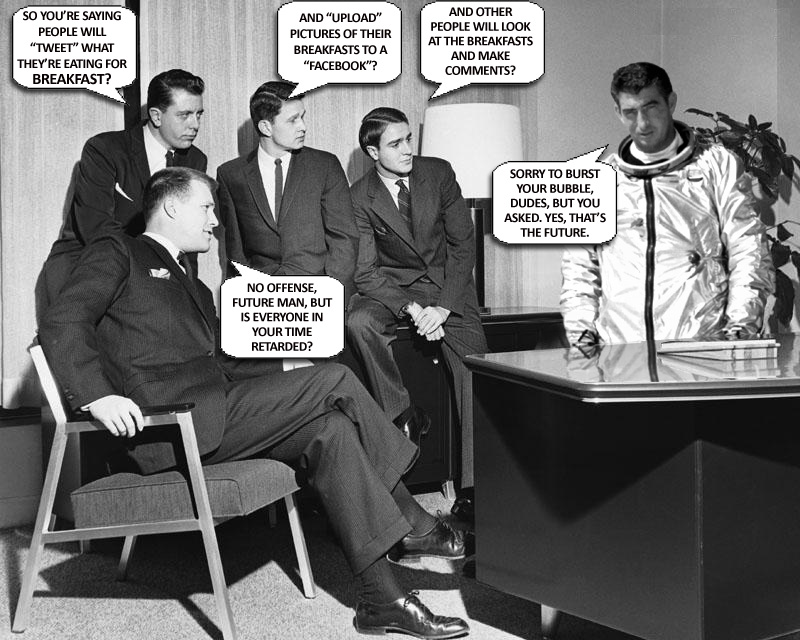
One of our bestest ad blog buddies, Where's My Jetpack?, is making it rain (as much as any blogger not named Seth Godin can make it rain anyway) with his "Futureman Describes Twitter" comic (above).

It was only a matter of time before his stuff got noticed enough to get stolen, copyright infringed, and passed around. Like a well-muscled Amish woman sweating over a butter churn, 'Packs consistently stirs up some of the best creative and advertising-centric content on the Webs of our Wide World.

Along with Bill Green's Make the Logo Bigger, Angela and Steve's AdRants, and Simon Veksner's Scamp, WMJP? is on constant rotation in our RSS feed. If you like smart things, make them a part of your daily reading, too.

The moral:

Link to better blogs
than yours to coax more traffic.
Now that's karma, holmes.


Previously in the Friday 5-7-5:
The Intern Sweatshop

Read more...
Friday Ad Haiku: Blog Pimpin'SocialTwist Tell-a-Friend

25 February, 2009

Intern Sweatshop: Let's talk about me

Good afternoon bloggytimeuniverse,
I’m the intern who's been picking up some of the slack around here. I've written a few recent entries - you know, the one's you really loved (thanks, AdRants!). Now, for a proper introduction. Here's Me, in the style of Facebook’s “25 Random Things About Me” mixed with the icebreaker 2 Truths and a Lie.


1. I lived in England last year.
2. I’m an atheist attending a Jesuit college.
3. I’m a terrible driver and have caused 3 car accidents.
4. I’m an Irish step dancer.
5. I can breakdance.
6. I don’t want to get married.
7. My OB/GYN gave me his son’s phone number.
8. I gave up watching TV for a year.
9. I have 2 tattoos.
10. I can play the electric piano quite well.


There are 7 truths and 3 lies. Can you guess which is which?


Yours,


Erica Campbell, Nice-to-Meet-You Intern


Read more...
Intern Sweatshop: Let's talk about meSocialTwist Tell-a-Friend

02 December, 2008

The internet is personal again.


I am no expert in social media. I know some things about Twitter, Facebook, and Linkedin, but I personally refuse to join in on the party. What good does having thousands of online friends do? "Well that's the point Jason, it's for keeping up with people you've lost touch with," my wife claims.

"I lost touch with them for a reason!" I say. "I don't care to keep in touch with them!" (Sorry to those of you out there this might apply to.)

McDermott recently attended a seminar on technology and social media, and one of the nuggets he shared really struck a chord with me. He said, "Social Media and online networking is making interaction with your clients much more personal and one on one. Gone are the days of shotgun advertising."

Wait. I always thought the rise of the internet and its effects on globalization is the reason we have lost personal connection in the first place. I mean, have you experienced customer support lately?

If I have to wait another hour to talk to "Jack" from India, only to get disconnected, I'm going to have a stroke. I yearn for the days when customer service was friendly and personal.

But, McDermott insists these new tools can bring that back. It can help us relate to clients, keep our finger on the pulse of their consumers, and even network with new potential clients.

When the internet and social media was first introduced it was a novelty (Electronic mail? Neat!). It quickly evolved into an unbridled information-attack, constantly feeding us videos of people getting hit in the privates, porn, and junk mail.

Further evolution has brought us networking tools that create a precision that was formerly non-existent when dealing with the Web. These tools enable us to track consumer opinion, react and up sell to the newest trends, and build more relationships in real time, from the comfort of our own desk. This kind of personal service and real time information gathering can pay big dividends in the ad world.

Now I'll never condone spending hours Facebook stalking (sorry Mrs. Stern) or using Facebook to help you stalk. But, maybe I will consider building my professional network online.

I mean, it can't hurt right?


--Jason Stern, Project Manager

Read more...
The internet is personal again.SocialTwist Tell-a-Friend

09 November, 2007

Facebook's Social Ads Gamble

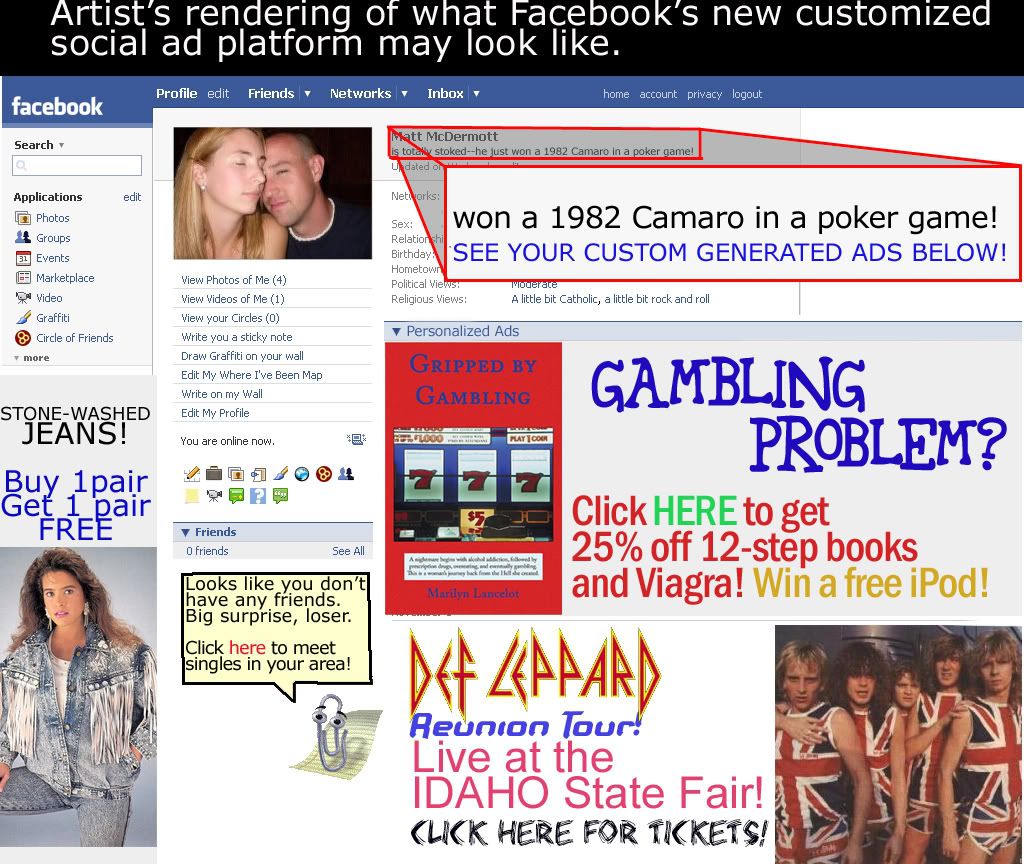
Social Ads? Okay, so the name is partially fluff. What ads aren't social? But naming conventions aside, Facebook's announcement of its new consumer-centric advertising model constitutes a major shift in the way messages can be delivered in the digital domain. I know, you’re probably thinking, “But how does it work, Jason? I didn't read any of the other 90,000,000 articles written on this same topic.”

Here's the basic concept. When a Facebook user visits a brand's Facebook page or external website in some cases, they'll be able to share and promote their interaction with the brand with friends. This user-initiated recommendation is then matched by Facebook with an advertisement created by the advertisers. Advertisers create these ads based on and directed towards demographic information obtained directly from traits Facebook users voluntarily post to their profiles, such as age, interests, hobbies, political affiliations, etc. Thus highly focused ads are directed "socially", from person to person, instead of from unknown external sources.

WTF!? (What the Facebook!?) Exactly. If it works it could be a watershed moment for Facebook and marketing in general. And that's really the question. Can it work?

(Click here to see englarged picture)

As I see it, there are a few hurdles, but all of them are surmountable. First, will users recommend products to friends? On the surface this may seem unlikely. But people do this all the time. In the real world it's known as "word of mouth" advertising. In the online world, I suspect brands will need to offer enticements to get the ball rolling, or make the recommendation process feel more like a game, but I don't think it will take much. People love to make their opinions known and share with friends where their minds are. Twitter is a perfect example of the level of social minutia people are willing to send and consume.

Until recently the assumption was that consumers didn't really care enough about products to visit their websites. Consuming the product was one thing, but who wants to read a website about their favorite brand of toothpaste? But a study conducted by ComScore throws strong doubt on this assumption. According to the study, "a majority of U.S. consumers visited at least one package-goods website during the three months ended in April, with search driving a substantial proportion of those visits."* And these visits were primarily initiated by the consumer. " Only 40% of searchers and 47% of non-searchers said they went to brand sites to seek promotional deals, compared to 73% and 58% respectively who went there seeking information and help."*

But is the demographic information advertisers are using to create their targeted messages reliable? After all, users voluntarily add this information, and are under no duress to make it accurate. Who hasn't fudged the truth a bit (or a lot, depending on how low your baseline is) in favor of themselves when creating an online persona. It's like online dating. Make yourself seem as attractive to other people as possible. They'll have plenty of time to be disappointed when they finally meet you.Ultimately, I think this is a non-starter. Yes, people lie. But I think mild exaggeration and understatement are the worst evils most people include in their online existence. After all, most online social linking (outside of dating) is between offline friends, already known entities. You can't get away with much when your friends are policing you. Plus, the point of online social linking is to find and interact with like-minded others, and lying defeats this.Of course, even outright lies make for useful information. If someone feels strongly enough about a particular idea, product or company to lie about it on their Facebook profile, they'll be interested in forwarding even incorrectly matched advertising messages to their friends and family.

Ultimately, I think socially distributed advertising's benefits will outweigh the detractors. Advertising sent within social interactions feels less like advertising and more like friendly recommendations, akin almost to viral marketing videos on YouTube. At least that's what Facebook and their prospective advertisers will be banking on. And I for one think it's great and highly recommend it!

*Source: Advertising Age - October 23, 2007 - "Study Finds Large Audience Online for Package-Goods Brands", Jack Neff (Look! I footnoted!)

Jason Bloom, Senior Avid Editor

Read more...
Facebook's Social Ads GambleSocialTwist Tell-a-Friend
The Renegade Agency Confessional - Blogged

  © Blogger templates The Professional Template by Ourblogtemplates.com 2008

Back to TOP