Showing posts with label twitter. Show all posts

06 July, 2011

C'mon, Brands!

We've all seen it happen.

An errant, rogue tweet appears and it is SUPER-EFFECTIVE, causing stunned silence and shaking heads. Within minutes, negative comments and tweets flood in condemning the brand and the offending update.

Quicker than you can hit the "Prnt Scrn" button, the offending Brand's social media teams scramble to investigate and eliminate, hoping that they can spare themselves and the company they represent from any damages caused by the thoughtlessness of a single ill-conceived tweet.


I understand the issues at play here; when I first got my smart-phone I was constantly updating my Facebook or Twitter just because I had thought of something interesting or funny. And, with advances in science and technology, instead of having to wait until I got back to my laptop or computer, I can just instantly record this apparently brilliant thought through my phone.

Maybe that’s exactly the problem- the ability to update social media sites as soon as the thought passes our brains. We no longer have a chance to realize that our clever post may not be as funny as we originally thought.

This seems to be happening a lot lately: companies or brands pulling a social media ‘faux pas’ and then scrambling to apologize and move past it.

In a world where communications can happen instantly and literally everything you've done online has the potential to live eternally, why are brands/companies not giving their updates a second thought before hitting the post button?

Pardon me if I borrow a bit from SportsCenter's “C'mon, Man!” but it makes me want to shout: "C'mon, Brands!"

Entenmann’s, more known for delicious donuts and cakes than for its social media presence, is the latest to put its virtual foot in its mouth with their #notguilty tweet.

Without question the Casey Anthony case is a sad, sad event. When news hit earlier this month of the not guilty verdict, everyone was weighing in on Twitter about the verdict using the #notguilty hashtag.

Entenmann’s social team, obviously looking for any opportunity to get their brand more visibility, concocted the following misguided tweet.

After taking a second to allow their brains to catch up with their fingers, they removed the tweet and not only apologized in a follow-up tweet but also in a second tweet with a note saying how sincerely sorry they were for offending people.

C’mon, Brands!

How many times is this going to happen?

How long until companies learn to predict what people will find funny and what they’ll find offensive?

Judging by the high frequency with which this has been happening lately, I speculate that it will be a long time before brands get wise and realize they can’t piggy back on hashtags to build their audiences and need to watch what they tweet.

Brands need to build their audiences the old fashioned way: by being responsive and forthcoming with content; not shoot for an “ironic-cool” vibe by making light of a serious issue.

With the amount of news-coverage that happens after all of these mistake tweets, you’d think that companies would learn from their compatriots and tighten the belts on their social media teams.

For some freakin’ reason, they don’t.

C’mon, Brands!

Simply put – go back to a simpler time and think before you tweet or update your company’s social media presences. Doesn't anyone remember what happened to Imus?
Despite how quickly you believe you can post and delete an update, someone can just as fast take a screenshot and upload it anywhere they want.

It’s great that you’re on those channels to begin with, just remember to play by the rules like everyone else. Or, do what you want, and enjoy the backlash.

Either way, we'll all be waiting and watching for the next Kenneth Cole...

Sean Sutherland, Associate Account Executive/Keyshawn Johnson Imitator

Read more...
C'mon, Brands!SocialTwist Tell-a-Friend

18 April, 2011

Intern Sweatshop: How Do You Using Social Media?

I remember when I thought that Facebook was pointless. I had the idea it was only used for people who were in college, and I wasn’t in school so I didn’t see a reason to sign up. People convinced me to check it out, and told me that more than just students were using it. Now my mother posts more on Facebook than I do.

The point is that everyone is using social media today, and it is used for more than just telling people what is on your mind. Social media can be used for many different reasons including locating people, gathering information, advertising, as a resume of sorts, but most importantly as a tool to connect with other people.

Think of what happened in Egypt as a prime example. A Google executive Wael Ghonim started a Facebook page that called for protests on January 25th, which is now known as the “Day of Wrath.” He called for the protests in response to the violent beating death of an Egyptian businessman, who was beaten to death after he planned on exposing corruption in the government. The page was named after the man who died, and was called “We are all Khaled Said.” Ghonim was arrested on January 28th and was released twelve days later. The rest is history.

I remember following a New York Times list on Twitter that posted people live in Tahrir Square as the news Mubarak had stepped down. One woman posted that she couldn’t stop laughing and crying at the same time, and I could follow Egyptian’s reactions as they were happening in real-time. It was so moving that I almost cried myself.

Ghonim used social media to broadcast his message, and gather people to form a revolution. This has spawned many other similar events in the Middle East such as Libya, Bahrain, and Yemen; and others are just now beginning to quell into a true social movement for change.

Social media allows for someone to get a message out quickly, and to a large number of people. Word spreads quickly on Facebook and Twitter, and news is almost instantaneous. With the recent earthquake and tsunami in Japan the news of the event came from social media first, with the actual news second going so far as to cite what they were seeing on Twitter as sources.

What do you think it would have been like on 9/11 if Facebook and Twitter were around then, and were used in the capacity that they are today? It could have been much easier for people to find out if their loved ones were okay via social media avenues. Imagine if social media was around during the times of the Titanic?

It is clear that social media is changing the way that information is disseminated. The news that Michael Jackson died shut down Twitter for a short period of time. This is an example of how often today people get their news from social media and from their friends. Who better to trust than your friends on social media?
Advertising has been changed tremendously and most companies now have social media sites. Even so, some companies have yet to utilize this avenue effectively for marketing purposes, they are left trying to answe the question: How does a Facebook page actually translate to sales?


The bottom line is that social media has an enormous impact on how societies today communicate with each other. If Facebook were a country, it would be the third largest in the world, and it is continuing to grow. It has become an avenue for unprecedented open communication. I think we have just now tipped the iceberg for how it will be used in the future. The question is… how do you use social media?

Robert Devereux , Account Executive Intern/Inquisitive Soul

Last Heard on the Intern Sweatshop: Apparently Our Custmers Like Our Crappy Commercials

Read more...
Intern Sweatshop: How Do You Using Social Media?SocialTwist Tell-a-Friend

19 November, 2010

Conan: Successful Social Media User

How does an ex-talk show host who has a very public spat with his old network for trying to change his timeslot, rebound after a do-not-appear-on-tv buyout deal, and end up at the top of the ratings?


The Answer: Social Media

Since his falling out with NBC in 2009, Conan was prohibited from appearing on television. Without his familiar zaniness outlet, Conan turned to one of the only places left for him to connect with his audience, a Twitter account.
This was literally the first fans would hear from Conan since the gag order.

Conan continually fed the masses of hungry fans who were bitter with NBC and Jay Leno for not supporting their uniquely-haired talk show host, bringing the #TeamCoco movement to a fever pitch.

Filling a stream with personal anecdotes and making headlines by following just one random Twitter user, Conan had tapped into the pulse of what drove his show, and in essence, himself to be such big hits.

Soon after, Conan also put on a brief 30-city tour, appropriately named "The Legally Prohibited From Being Funny on Television Tour, which featured such acts as Conan and Jim Carrey dressed as Kick Ass and Superman performing Five for Fightings' "Superman (It's Not Easy.)"


Around this time he launched the appropriately named TEAMCOCO, which became the nexus for all things Conan including a special announcement in September that he would be launching a new show on TBS in November.

He followed this up with a Facebook where he would randomly take a Facebook fan's question and answer them on his Youtube channel.

After that it's a whirlwind of a live 24-hour webcam event, a mock first show called Show Zero, and of course the Team Coco blimp which featured it's own Foursquare badge if you were lucky enough for it to float over your city.

Conan O'Brien's social media experience illustrates one of the most successful uses of social marketing by a celebrity in connecting with their audience.

He had interactions and influence numbers that marketers drool over.

And what was the result of all of these social shenaningans?

When Conan's show finally premiered on TBS, the audience he had gained through his career at Late Night with Conan O'Brien and the Tonight show, the audience he had gained through Dancing Tacos, I Miss Conan videos, and exclusive Foursquare badges tuned in and put him on the ratings throne of late night television.

With his attention back toward his TV show, will the stream of content be hindered so much so that Team Coco's social presense dwindles? Or was this all merely a stop gap until he made it back to the airwaves?

Sean Sutherland, Associate Account Executive/Team Coco supporter

Read more...
Conan: Successful Social Media UserSocialTwist Tell-a-Friend

12 November, 2010

Ads on Twitter Are Okay By Me


Being a part of the *special* 900,000 users that access Twitter through Hootsuite, couldn't help but notice something new popping up in my Feed.

A dull yellow highlight around the word Promoted Tweet (or Promoted depending on where you look) with a message from a big name brand like Nintendo or Best Buy, brands I don't actually follow.

These brands have paid a premium to Twitter to appear in users feeds via the Promoted Tweet veil.

Like most entrepreneurial ventures in life, it all comes back to earning/making money.

And this is the way Twitter chose to do it.


Announced back in April, Twitter has utilized these Promoted Tweets in a way where they're not terribly annoying, in my opinion that is.

Unlike other websites, where ads appear in the typical right hand column or in Banner ads, these purchased advertisement tweets show up in general feeds and haven't been too much of a distraction so far.

These ads feel like a natural extension of the service, much like other advertisements on the web.

When I go to YouTube, I can expect to watch commercials now.
When I want to read an article on the Baltimore Sun's website, some ads appear about a Baltimore mom making $134.95/hr.
Head to any of the big networks that host old episodes for streaming, and you're going to be treated to the same 30-sec ad from a sponsor at regular broadcast commercial spots.

Okay, so those are annoying, but we still use those services. Following this line of logic, I wouldn't expect Twitter users to be bothered by this new form of advertising.

I've done searching on Twitter, and am finding that few seem to share my apathetic attitude toward these ads:


Maybe I'm just not getting hit as hard as other users, but I really don't think these Promoted Tweets are the devil.

If anything, they're a smart way of reaching Twitter users with brand messaging. At least we're not being forced to watch a :30 sec Dove spot everytime we refresh our feed.

Jury's still out on all of this. What do you think about Promoted Tweets on Twitter?

Sean Sutherland, Associate Account Executive/Promoted Tweeter (not really)

Read more...
Ads on Twitter Are Okay By MeSocialTwist Tell-a-Friend

01 August, 2010

6 Foursquare badges that should exist

I've been mulling over a post on social media pet peeves, stuff that people do on any number of channels that annoy me by cheapening, spamming, or otherwise bumming out the social web. But I realized that most of my gripes lately have been with Foursquare offenders.

So I sat down with my wife - a bonafide Foursquare junkie - and we put together a handful of badges to celebrate the sins of the socially intrepid. We've all been guilty of one or more of them at some time. Or many times.


Liar, Liar:
You big, fat cheater. This is you're 10th check-in at a venue you're more than 1,500 meters away from. Is life really that empty?


Overworked: More than 50% of your check-ins are at your place of employment. You need a raise. Or a life.


Why Spy?: 9 out of 10 check-ins are "off-the-grid". OK, Jason Bourne. We get it. You're secretive. Here's a suggestion: if you don't want people to know where you are, stop using a social network whose key function is to tell people where you are.

Working Lunch: This is the 100th restaurant check-in that you've also broadcasted to your LinkedIn status. Unless you work for Zagat, maybe you should rethink telling your professional network every time you eat at Rita's Jambalaya Shanty.


Home, Sweet Huh?: Congratulations! You're mayor...of your house. Along with being king of your bird feeder and magistrate of your tool shed, you've really accomplished something. Celebrate by deleting your Foursquare account.


Bo-Ring!: More than 75% of your check-ins are at venues with little or no relevance to your network - or anyone else. Tip: No one needs to know every time you pump gas at a Sunoco or pull into every train stop between Baltimore and DC.


Any suggestions from the peanut gallery? Share your Foursquare pet peeve badge ideas in the comments.


Other posts in the neighborhood: Please to be robbing me.

Read more...
6 Foursquare badges that should existSocialTwist Tell-a-Friend

14 June, 2010

Twitter was so much simpler in the 1930s

Use your computing machine's navigation tool to "click" on the photograph for extra-ordinary size. Bully!

Further proof that the Greatest Generation really was the greatest generation: They invented Twitter.

Everyone just pack up and go home. Millennials, turn the light off before you leave.

(via Modern Mechanix by way of Urlesque.)


Other old timeyness: Branded content in 80s; His Master's Voice

Read more...
Twitter was so much simpler in the 1930sSocialTwist Tell-a-Friend

04 May, 2010

5 Ways to Be Authentic: Copy Us

Read an interesting post at PR-Squared the other day. It talked about being "authentic" in the twittering world when you work for a company/brand that may not agree with your desired level of "authenticity."


When I hear the word authentic, I think both being original and not being a corporate shill. Now we're all in advertising, so we're all shills to somebody. And as far as freedom to be original, at the confessional we work for a pretty relaxed company. Sandals are unisex office footwear around these parts, and interns here for interviews are usually the most dressed up people in the building (with the exception of our Account Director's, but they have to leave the office to go make us money, so we forgive them). So it's a relaxed, fun atmosphere. That being said, I did come up with some quick thoughts on how to maintain some level of personality and interesting level of thought for bloggers, twitterers or people who, well...these people.


1) First ask, what are the personalities of your brands and your higher-ups. If your image is stiff and the higher ups like it that way, you’re probably going to be stiff too.


2) Second what are the personalities of your clients. They may have a stiff brand, but they may be just like you; however, if your clients are stiff and and may be offended by your ribald wit, be careful, and try not to praise their direct competitors.

3) That being said, work within your boundaries. You don’t have to be shocking or “edgy” to be effective or funny. If you keep pieces informative and topical, smart people will want to read them. If you feel they're dry, keep them short and people won't have time to think, This is kind of boring, because they'll be finished reading before they get to that thought.


4) If you work for a a more “stiff” company, grow your personality slowly. Start off walking the company line, then work in a little flavor or humor. If no one bats an eyelash, continue to work in personality. If you go too far, trust me, you’ll here about it, but by moving slowly, you minimize your chance of going so far that the effects will have any lasting repercussions. In my very first blog posts, I didn't attempt to draw an allusion to myself and this fashionable orangutan, but when people got a slow feel for my personality, that tone and sense of humor made complete sense.


5) Style is subjective. Be yourself, but be smart first. No matter how funny you think you are, the whole world may not agree. I remember watching a guy completely bomb at an open mic comedy night, which happens. Now I assume he was "the funny guy" among his friends, but a big joke he had about constipation and pulling on some sort of chain a la tug of war to rectify the matter was too gross for the crowd's taste. A valuable lesson I learn every day: My funny ≠ everyone's funny. Oh, and no matter how funny you actually you are, you inevitably will say something too stupid or too offensive. People keep telling me I'm going to do that some day. So, I go back to: Be Smart.


In 3 years of being a blog, we've had advertisers call us out and tell us our opinions were wrong. We said, You have a right to your opinion. We’ve had also had 2 or 3 posts we took down–and that was mainly because we didn’t think, Oh, right, we probably shouldn’t praise one of our client’s direct competitors. As much as we thought a campaign was pretty smart, it's just not wise to make the people who put bacon on your sandwich feel you like the other guy better. Besides, that was probably an intern anyway. Silly interns.


But we've had good conversations with advertisers who responded to both criticism and praise. We've befriended many other wise people in the blogosphere, who thought we were smart enough to follow us, and we do the same. And we've brought in new clients, because they read us and thought, These guys might actually have a clue.

If you're smart, the time you spend blogging and twittering may actually make you some money...provided you don't completely suck at it.


--George C. Convery, Copywriter

Read more...
5 Ways to Be Authentic: Copy UsSocialTwist Tell-a-Friend

12 April, 2010

Intern Sweatshop: Has Social Media Gone Too Far?

Facebook, Twitter, MySpace… just to name a few. Social media is great, right? Catch up with old friends, see how everyone’s doing, and even advertise for your company. But as the saying goes, it’s all fun and games until someone gets hurt.

Have you heard of the newly popular foursquare? No, not the playground game – the social networking site. You download an application onto your cell phone, and then as you go places, you “check in” on foursquare. You are then awarded “points” and “badges” for updating your location. So, it’s an application that encourages you to explore different locations and let friends know what you’re doing. No harm in that, right?

Wrong. Consider this scenario: You go out with some friends to your favorite restaurant, and you check in via foursquare, “in New York, NY: White Castle has the best burgers!” Guess where everyone now knows you’re at… you guessed it, the White Castle in New York, NY. But what’s more important, guess where people now know you're not: your home.

foursquare seems to have just gone a bit too far. I’m sure the creators had no intention of making this dangerous, but this can cause problems with stalking because people know your location, as well as theft because people know when you aren’t home. The website pleaserobme.com was created to raise awareness about “over-sharing.” It scanned tweets from twitter and check-ins from foursquare and posted them on their website to show people who were not in their home. Recently, the site has stopped showing the tweets or check-ins but still encourages people to not share anything they don’t want everyone to know.

This link shows you how a guy figured out a woman’s age, location, profession, shopping habits, email address, and phone number in a matter of minutes from social networking sites. Quite scary to know how much someone can find out about you just by a few clicks of the mouse. Here's another link to an article about a woman who claimed to have been robbed after posting on Facebook that she would be out for the evening.

So, while social media may seem like a great thing, just be careful what you do and what you say. Whether it's a Facebook post a potential boss may find or a foursquare check-in a potential stalker may look at, once it's on the Web, it's hard to take it back.

--Tara Cammarata, Creative Department Stealth Intern

Last time on the Intern Sweatshop: Is Dove Men+Care really targeting men?

Read more...
Intern Sweatshop: Has Social Media Gone Too Far?SocialTwist Tell-a-Friend

01 December, 2009

Twitter Billboard: When Social Media Attacks

It seemed like a solid concept: A news station in Alabama decided to pipe their Twitter feed into their electronic billboard to update passersby with their latest stories of the day. Can't disagree with the intention.

After all, social media works best when it's a part of a coordinated marketing effort that includes a mix of tactics. New media and traditional go well together. Like new beer and old wine. That's good, right?

The station makes a living breaking brand-spanking news. And they figured, Twitter's great at doing that.

Unfortunately, it's also great at biting the unwitting in the ass publicly:


No one ever suspects the smiling, clean-cut, racially harmonic news anchor team next door.


Kinda reminds you of those old contextual ad horror stories (that still happen).

Other ad fails: Van Wrap F-Up; Bowling doesn't translate well.

Read more...
Twitter Billboard: When Social Media AttacksSocialTwist Tell-a-Friend

28 August, 2009

How to be a Social Media Jerkhole: Talk about yourself all the time.

Click to feel the bigness. (from xkcd.com)

This is the inaugural post in a series that will probably be abandoned when the next big project at the agency comes down the pike and buries me (in a good way, of course). But for now, let's talk about social media. I mean, really talk about it.

More specifically, let's talk about brands. Brands aren't that much different than people.

People are inherently narcissistic. We love to talk about ourselves. So do brands. And with the proliferation of digital channels, there are more ways to do it then ever.

I've got a problem with that. Because, unless you're a good friend or you're saying something really interesting or you're paying me to listen to you, I don't care how awesome you think you are. I'm pretty sure most people would back me up on this one.

So here's my first tip for brands looking to break off a little social sumpin'-sumpin':

Stop talking about yourself all the time.

Don't think I haven't noticed. We've all noticed. The spammy self-promotional tweets. The over-amped, unsolicited press releases to bloggers.

You may own that media buy. That 1/4 page ad. That :30 broadcast spot. But you don't - and can't - own a conversation that happens off the reservation. It belongs to the people, comrade.

I'm always reminded of the not-so-old adage from Hugh McCleod:


Brands shouldn't be afraid to go off script. In fact, I encourage it to clients. It breaks the barrage of sanctioned messages consumers are used to seeing. It makes a brand seem more human.
Some ideas:
  • Retweet a dumb video of puppies.
  • Share photos of the marketing director whiffing at the company softball game.
  • Write a company blog about something you're passionate about- and are not paid to do at work (P.S. I strongly recommend that you avoid religion and politics. The discussions they rile up rarely end well.)
  • Promote someone else's blog post that you like - maybe even a competitor (If you're confident in your service and dedicated to giving your customers content of interest, what have you got to worry about?)

Just like in real-life interactions, no one wants to talk business all the time. Every now and then undo that top button. Loosen your tie. Lighten up a little. And take the emphasis off your business. You'll find it'll make folks more willing to listen to that promotional bit your brand throws out into the social ether next time.

So, when you're not talking about your business, what are you talking about?

Read more...
How to be a Social Media Jerkhole: Talk about yourself all the time.SocialTwist Tell-a-Friend

13 April, 2009

The less you talk, the more I love you.

by M.M. McDermott


Count on someecards to dredge the real muck of the human heart. While its twitspiration is obvious, really, couldn't it be the rule of engagement for most relationships? Husband and wife. Teacher and student. Advertiser and consumer. It's all the same.

Think about that while I kill my heart with Easter ham leftovers for breakfast.

Thanks to our favorite expatriate for the e-bon mot.
Je hais les bérets et Camus m'ont toujours ennuyé.

Read more...
The less you talk, the more I love you.SocialTwist Tell-a-Friend

24 March, 2009

I hate Facebook's stupid face. Or do I?

Great article in Slate pointing out what H.L. Mencken always knew: the masses are easily cajoled into liking whatever the Illuminati/Politicati/Economati tell them to. It just takes time. Admit it or not, even the most liberal Web 2.0 evangelist is nothing more than a crotchety old man shaking his cane at the neighborhood kids from his lawn chair.


We hate change. We like things comfortable. We like things easy.

But, over time, we'll adjust. Hell, we adapted to the crappy, discombobulated Facebook interfaces of olde. And we'll adapt to this one. And this time, it'll be even easier seeing as how Facebook stole everything but the whale from Twitter.

We'll accept this version of Facebook. And the next one. And the next one.

Carry on, fellow social media succubuses.

Read more...
I hate Facebook's stupid face. Or do I?SocialTwist Tell-a-Friend

17 March, 2009

Twitter's Dirty Bird

Twitter works because of its simplicity. The only complex part of it is how the individual uses it - meeting people, breaking news, sharing information, or droning on about your grey, empty life and the insignificant events that comprise it.

Of course, the fact Twitter has a wellspring of 3rd party applications that are actually useful is a leg up, particularly interfaces like Tweetdeck, Twhirl, and Digsby. But I also have a roll of quarters in my pocket for the myriad of apps that exist solely for entertainment or ego's sake.

Here's a pretty sweet list of Twitter tools guaranteed to suck you in like a gaggle of geese into jet turbine of unproductivity.


From the list, my new favorite: Cursebird (actually found this first via Geo. Parker over at AdScam). Cursebird's a little Twitter search engine that scours a user's tweets for instances in which they've bandied about an expletive - from the tame to the "Queen Mother of all dirty words." Then, it ranks the user on a cuss-scale of 1-100. I was impressed that, out of 4 million-odd users, I ranked a solid 13,969 with a score of 96.

Probably my best score since finger-painting was graded.

Read more...
Twitter's Dirty BirdSocialTwist Tell-a-Friend

13 March, 2009

Friday Ad Haiku: Filchbook

You know you're on to something when Facebook wunderkind Mark Zuckerburg pilfers what makes your utility great. Twitter, as if it needed the validation, was obviously the primary inspiration for Facebook's face lift - namely the addition of a real-time friend stream and a reworking of the status window.

(Click pic=big pic)

Personally, I'm not impressed. Using Facebook is the social network equivalent of unhooking a bra on prom night: full of good stuff, but way more complicated than it should be. A parade of sketchy apps and pokes and super pokes and ultra-craptomic pokes. Sure, I still use it frequently, but it's more in spite of all the moving parts, not because of them. Unfortunately, every step Facebook takes to be more like Twitter gets it that much further from what makes it unique.

Social behemoth.
Useless apps. Still, how else would
I stalk old classmates?


Previously in the Friday 5-7-5: Responding to a-hole blog comments

Read more...
Friday Ad Haiku: FilchbookSocialTwist Tell-a-Friend

04 March, 2009

Twittery Twitterness: The Daily Show's tweet release; Google CEO shakes fist, tells Twitter to get the hell off his lawn.


Jon Stewart's curmudgeonly take on Twitter is echoed (for real) by Google CEO/Professional Twitter-hater Eric Schmidt.

Calling it the "poor man's email system", Schmidt manages to not only alienate millions of Twitter users, but also look like a titanic dufus when he confuses the character limits in a tweet with those of mobile text. After hearing that, I suppose this makes more sense now:


(picture clickin von biggun)

Previous Twitter worship in this space.

Read more...
Twittery Twitterness: The Daily Show's tweet release; Google CEO shakes fist, tells Twitter to get the hell off his lawn.SocialTwist Tell-a-Friend

26 February, 2009

Friday Ad Haiku: Blog Pimpin'

(click photo to initiate bigness)

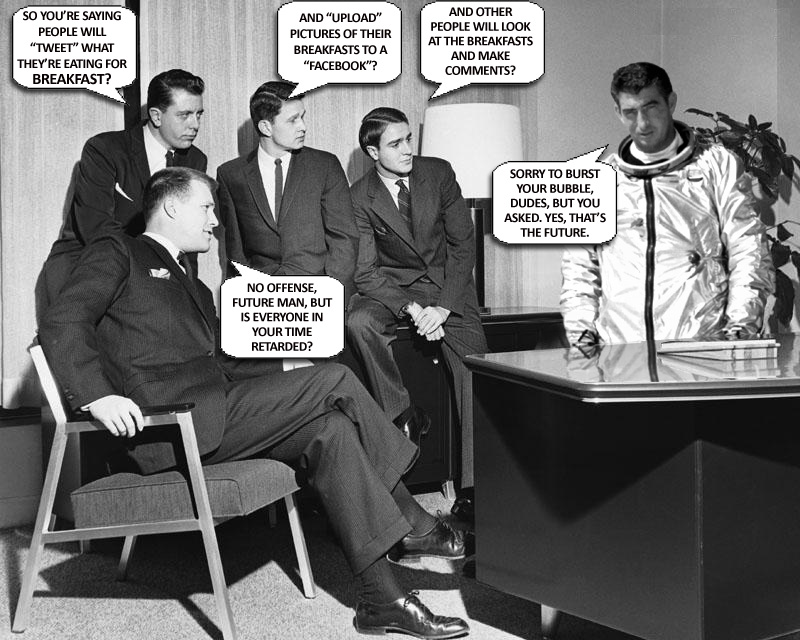
One of our bestest ad blog buddies, Where's My Jetpack?, is making it rain (as much as any blogger not named Seth Godin can make it rain anyway) with his "Futureman Describes Twitter" comic (above).

It was only a matter of time before his stuff got noticed enough to get stolen, copyright infringed, and passed around. Like a well-muscled Amish woman sweating over a butter churn, 'Packs consistently stirs up some of the best creative and advertising-centric content on the Webs of our Wide World.

Along with Bill Green's Make the Logo Bigger, Angela and Steve's AdRants, and Simon Veksner's Scamp, WMJP? is on constant rotation in our RSS feed. If you like smart things, make them a part of your daily reading, too.

The moral:

Link to better blogs
than yours to coax more traffic.
Now that's karma, holmes.


Previously in the Friday 5-7-5:
The Intern Sweatshop

Read more...
Friday Ad Haiku: Blog Pimpin'SocialTwist Tell-a-Friend

23 January, 2009

Friday Ad Haiku: Twitter


Damn. It's been some time since we got all 5-7-5 on your behinds. Been busy around here, grinding it out as of late. New biz. New pitches. New projects. Sure, it's great. But it really cramps my efforts to be as unbillable as humanly possible. Luckily, there's still Twitter to kill my timesheet ratios.

Actually, Twitter's been popping up in a lot of conversations lately, both at the agency and with some of our clients. Twitterer coverage of the airliner splash-down in the Hudson has certainly enticed the mainstream media consumer to consider the app's value beyond simply stalking interesting strangers and sharing TwitPics of what you're eating for lunch (by the way, both are excellent wastes of time).

Folks are starting to see some of the multi-layered benefits of Twitter, including its role as a raw source for breaking news and its impact as a conversation amplifier - both in reach and in immediacy. Just take a look at how the Twitter world lit up like a Christmas tree during the presidential inauguration.

Here's to living life, 140 characters at a time.

@boss fired me 4
twittering 2 much.
here's a
picture of my lunch.

Previously in the Friday 5-7-5: Holiday Cards

Read more...
Friday Ad Haiku: TwitterSocialTwist Tell-a-Friend

02 December, 2008

The internet is personal again.


I am no expert in social media. I know some things about Twitter, Facebook, and Linkedin, but I personally refuse to join in on the party. What good does having thousands of online friends do? "Well that's the point Jason, it's for keeping up with people you've lost touch with," my wife claims.

"I lost touch with them for a reason!" I say. "I don't care to keep in touch with them!" (Sorry to those of you out there this might apply to.)

McDermott recently attended a seminar on technology and social media, and one of the nuggets he shared really struck a chord with me. He said, "Social Media and online networking is making interaction with your clients much more personal and one on one. Gone are the days of shotgun advertising."

Wait. I always thought the rise of the internet and its effects on globalization is the reason we have lost personal connection in the first place. I mean, have you experienced customer support lately?

If I have to wait another hour to talk to "Jack" from India, only to get disconnected, I'm going to have a stroke. I yearn for the days when customer service was friendly and personal.

But, McDermott insists these new tools can bring that back. It can help us relate to clients, keep our finger on the pulse of their consumers, and even network with new potential clients.

When the internet and social media was first introduced it was a novelty (Electronic mail? Neat!). It quickly evolved into an unbridled information-attack, constantly feeding us videos of people getting hit in the privates, porn, and junk mail.

Further evolution has brought us networking tools that create a precision that was formerly non-existent when dealing with the Web. These tools enable us to track consumer opinion, react and up sell to the newest trends, and build more relationships in real time, from the comfort of our own desk. This kind of personal service and real time information gathering can pay big dividends in the ad world.

Now I'll never condone spending hours Facebook stalking (sorry Mrs. Stern) or using Facebook to help you stalk. But, maybe I will consider building my professional network online.

I mean, it can't hurt right?


--Jason Stern, Project Manager

Read more...
The internet is personal again.SocialTwist Tell-a-Friend

02 September, 2008

Mad Men's Twittergate

I got to thinking recently. For the good of mankind, this doesn't happen often.

It was about AMC's short-lived (and short-sighted) temper tantrum over the Twitter accounts that popped up featuring characters from Mad Men. If you have no idea what I'm talking about, stop reading now and click on this video of a guy falling off a ladder; you'll enjoy it more.

So, I was thinking. This could be one of the first bonafide shots across the bow of that recently launched little sailboat we like to call social media. While no one can honestly say where it's headed, we can be sure it'll sink a lot of brands if they continue to approach it like a guy playing the piano wearing catcher's mitts.

Don't get me wrong. Twitter isn't the Second Coming. Hell, 90% of the people I've spoken to have never heard of it. But it's an important piece of brand conversation, and more importantly, it's a perfect platform for consumer evangelism. With Mad Men, you've got fans so rabid for the franchise that they're willing to spend time talking about it, immersing themselves in it. So naturally, you do the logical thing: sic the lawyers on 'em (well, on Twitter anyway).

It's sad and absurd. So many brands still can't grasp the notion that, to bring in the ever-evolving consumer, they have to let the consumer take over the conversation now and then. Let out the trot line a little. Take a risk.

Part of forging any lasting relationship is conceding some control.

It's about trust. It's about caring as much about a customer's satisfaction as they do about their money. And it's what will separate their business model from that of prostitutes and pyramid schemes. Because, you know, they have business models, too.

Speaking of Mad Men: The Real (Lame-o) Sterling-Cooper; Don Draper gets me hot and bothered; Mad, black, and not gonna take it anymore.

Read more...
Mad Men's TwittergateSocialTwist Tell-a-Friend

09 November, 2007

Facebook's Social Ads Gamble

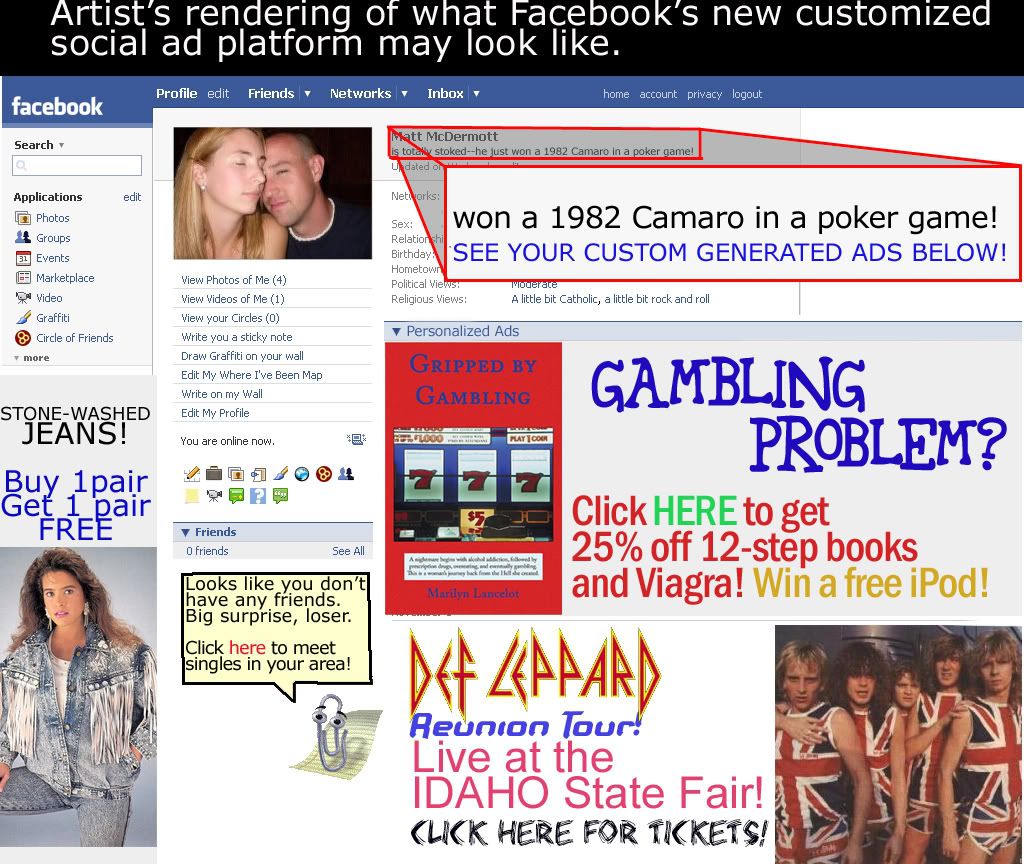
Social Ads? Okay, so the name is partially fluff. What ads aren't social? But naming conventions aside, Facebook's announcement of its new consumer-centric advertising model constitutes a major shift in the way messages can be delivered in the digital domain. I know, you’re probably thinking, “But how does it work, Jason? I didn't read any of the other 90,000,000 articles written on this same topic.”

Here's the basic concept. When a Facebook user visits a brand's Facebook page or external website in some cases, they'll be able to share and promote their interaction with the brand with friends. This user-initiated recommendation is then matched by Facebook with an advertisement created by the advertisers. Advertisers create these ads based on and directed towards demographic information obtained directly from traits Facebook users voluntarily post to their profiles, such as age, interests, hobbies, political affiliations, etc. Thus highly focused ads are directed "socially", from person to person, instead of from unknown external sources.

WTF!? (What the Facebook!?) Exactly. If it works it could be a watershed moment for Facebook and marketing in general. And that's really the question. Can it work?

(Click here to see englarged picture)

As I see it, there are a few hurdles, but all of them are surmountable. First, will users recommend products to friends? On the surface this may seem unlikely. But people do this all the time. In the real world it's known as "word of mouth" advertising. In the online world, I suspect brands will need to offer enticements to get the ball rolling, or make the recommendation process feel more like a game, but I don't think it will take much. People love to make their opinions known and share with friends where their minds are. Twitter is a perfect example of the level of social minutia people are willing to send and consume.

Until recently the assumption was that consumers didn't really care enough about products to visit their websites. Consuming the product was one thing, but who wants to read a website about their favorite brand of toothpaste? But a study conducted by ComScore throws strong doubt on this assumption. According to the study, "a majority of U.S. consumers visited at least one package-goods website during the three months ended in April, with search driving a substantial proportion of those visits."* And these visits were primarily initiated by the consumer. " Only 40% of searchers and 47% of non-searchers said they went to brand sites to seek promotional deals, compared to 73% and 58% respectively who went there seeking information and help."*

But is the demographic information advertisers are using to create their targeted messages reliable? After all, users voluntarily add this information, and are under no duress to make it accurate. Who hasn't fudged the truth a bit (or a lot, depending on how low your baseline is) in favor of themselves when creating an online persona. It's like online dating. Make yourself seem as attractive to other people as possible. They'll have plenty of time to be disappointed when they finally meet you.Ultimately, I think this is a non-starter. Yes, people lie. But I think mild exaggeration and understatement are the worst evils most people include in their online existence. After all, most online social linking (outside of dating) is between offline friends, already known entities. You can't get away with much when your friends are policing you. Plus, the point of online social linking is to find and interact with like-minded others, and lying defeats this.Of course, even outright lies make for useful information. If someone feels strongly enough about a particular idea, product or company to lie about it on their Facebook profile, they'll be interested in forwarding even incorrectly matched advertising messages to their friends and family.

Ultimately, I think socially distributed advertising's benefits will outweigh the detractors. Advertising sent within social interactions feels less like advertising and more like friendly recommendations, akin almost to viral marketing videos on YouTube. At least that's what Facebook and their prospective advertisers will be banking on. And I for one think it's great and highly recommend it!

*Source: Advertising Age - October 23, 2007 - "Study Finds Large Audience Online for Package-Goods Brands", Jack Neff (Look! I footnoted!)

Jason Bloom, Senior Avid Editor

Read more...
Facebook's Social Ads GambleSocialTwist Tell-a-Friend
The Renegade Agency Confessional - Blogged

  © Blogger templates The Professional Template by Ourblogtemplates.com 2008

Back to TOP