Showing posts with label youtube. Show all posts

30 June, 2010

From the Intern Sweatshop: Little Susie Says Buy Revlon, So You Should Totally Do It!

The basic equation for a successful Web endorsement is simple: multiply word-of-mouth marketing effects with the extensive reach of the Internet. Thank you, social media.

For the first time since 1980, the Federal Trade Commission has updated their Guides Concerning the Use of Endorsements and Testimonials, putting the actions of bloggers and vloggers in the spotlight. The main focus of the October 2009 revision is that the relationship between a marketer and blogger must be disclosed, especially if material connections exist. Basically, if a blogger is being compensated in any way (gifts, money, etc.) for the mention of a particular product, this information must be disclosed to their audience.

The new laws have left vloggers on YouTube in the center of the endorsement controversy. Cosmetics companies and clothing retailers, as well as bath and body product manufacturers have been using YouTube to tap into their younger markets with their vlogging peers. It used to work like this: a YouTube “beauty guru” would receive free products and provide a positive review without disclosing their compensation. Information about where viewers could purchase the product would then be provided in the information bar of the video. Genius.

A vlog is way more effective than a commercial to reach this audience on many levels. Young women are actively seeking out this information; it’s different from being bombarded with commercials in the middle of Gossip Girl. They are viewing a positive product review and learning how to use the product, broadcasted from the bedroom of a girl who has a lot of really trendy stuff. Some of these videos are even more than ten minutes long, forget the thirty second spot.

Perhaps the most crucial element of this marketing scheme is the perception of credibility to this audience. Credibility seems to be based on the number of subscribers rather than accreditations or experience. Some of these users currently have more than 300,000 subscribers and are partnered with YouTube, making money off advertisements in addition to companies that sponsor them. With agents, lawyers, and spreads in magazines, YouTube super users may soon even fall into the category of celebrity endorsers. But isn’t that how it works in high school? The girl with the most friends always has the most influence, right?

The FTC policy has rocked the credibility of these “gurus,” and these ladies have had to bat their eyelashes even harder to regain the trust of their viewers. Vlogs have now been accompanied by a cutesy little note to the FTC for regulation compliance. This text ensures that regardless of compensation – their opinion is honest. They go a little something like this: “Some products I bought with my own money, some were given to me at NYC fashion week, and some were sent to complete this look. NYX Cosmetics is compensating me for this video and it is my own opinion.” Or in other words, Yeah, so I got this lipstick for free. I am really raving about it because, well, I am getting paid to talk about it. Honestly, I swear!

The FTC’s current policy is that each decision regarding misleading endorsements and testimonials will be decided upon on a case-by-case basis. Well, that’s a bit blurry. Sounds like a way to scare and protect minors at the same time to me. They seem to be the majority offenders. I imagine the legalities of a retailer entering into a material relationship with a minor may become complicated beyond the limits of the FTC. However, the FTC needed to do something about this, so I guess writing up some rules that may never have consequences was the solution. Let’s be real, the FTC doesn’t have time to launch an investigation on the thousands of bloggers and vloggers supporting products and brands.

In April 2010, the FTC conducted its first investigation based on these laws when Ann Taylor Loft hosted a preview of their summer collection for bloggers. The issue: bloggers who posted coverage of the event on their blogs would be entered into a gift card drawing and given a special gift. The concern of the FTC was the lack of disclosure regarding compensation for coverage. Ultimately, action was not taken against Ann Taylor Loft. Surprise, surprise.

The entire situation speaks to the closer eye the FTC has been keeping on the blogosphere. No one can deny the dynamic social media has added to advertising. It enables marketers to reach selective audiences and is extremely personal. The draw to bloggers and vloggers is their authenticity, but authenticity is put into serious question when they are being gifted and paid for their positive opinions.


And by the way, I was not compensated for this blog post and these are my honest opinions. Renegade is the best place I have ever worked, thanks for the three credits guys ♥!


If you are interested, the text of the FTC’s Guides Concerning the Use of Endorsements and Testomonials can be viewed here. Want to check out these videos in action? Just click on the “How To & Style” tab on YouTube.com.

Ashly Oehrl, Web-wise Creative Department Intern

Read more...
From the Intern Sweatshop: Little Susie Says Buy Revlon, So You Should Totally Do It!SocialTwist Tell-a-Friend

08 September, 2008

That Soft, Subtle Baseball Bat to the Kneecaps

I've been sitting on this for a while, waiting for the baseball season to really hit full stride before I broke it out.   But with my favorite team currently water-proofing the basement of the American League East, what's it matter anymore?  


To hell with it:

I stumbled onto a series of "instructional" baseball videos, Hardball Made Easy, sponsored by Easton and hosted by career minor leaguer "Scrappy" Ron Stilanovich.  Scrappy Ron shares his nuanced approach to teaching the game, from blocking the plate to fighting off a hobo ambush, while pro ball players stop by to teach painful lessons like learning how to lean in to a 95 mph fastball.  


At the end of each video, viewers get a quick glimpse of Easton's new HitMatrix bat in action as major leaguers turn home plate into a veritable launch pad.  While it's an aluminum hitgasm for any kind of serious baseball player, the lackluster view count may underscore the waning popularity of our national past time.   The most popular episode had about 45K views--not that impressive considering a couple hundred of those views were me, thoroughly soused after company softball games, clicking and laughing to myself before everything went dark.

The videos are entertaining and on point; the writing is big and dumb, right up the alley of teenage players. But the marketing folks at Easton dropped the ball on this one.  They failed to drive traffic to the videos, dooming them to the fate of most would-be virals.  Where's the point of purchase tie-in?  The targeted media buys during the Little League World Series?  The only collateral I could find was a text link to the videos buried in the bowels of their website.   It's a shame, really: a nice little project that no one will ever see and probably won't amount to much.

Kind of like playing for the Kansas City Royals. 


Read more...
That Soft, Subtle Baseball Bat to the KneecapsSocialTwist Tell-a-Friend

11 July, 2008

Friday Ad Haiku: Streaming Media

Youtube, Sirius Satellite Radio, watching TV on Web, downloading anything and everything. That's the kind of stuff that can make your T-1 line run like it's 24K. So, to the ADHD officemates who can't live without the newest Justin Timberlake video playing 24/7, this Friday Haiku is for you.

Friday Ad Haiku: Streaming Media

Been uploading to
The ftp server for
Almost half an hour.

Could you stop streaming
Mr. Belvedere for the
Next five minutes? Thanks.

--Captain Awesome, Copywriter

Last Week on the Friday 5-7-5: 4th of July Sales

Read more...
Friday Ad Haiku: Streaming MediaSocialTwist Tell-a-Friend

10 April, 2008

Trucks Follow-Up

Trucks has been on the web for barely a week, and after receiving nearly 30,000 hits (well short of Gorilla’s current 2.2 million) there are already multiple parodies featuring Europe (the band, not the country), The James Bond theme, a BBC news report voiceover, two with tags for British Airways, Bon Jovi, Huey Lewis and the News, one with no audio at all, a Vandals cover of Don't Stop Me Now, and of course, Phil Collins back in his Genesis days. I guess some people out there just can’t enjoy their Cadbury Dairy Milk without the man who replaced Peter Gabriel. Anyway, enjoy.


Livin’ on a Prayer—Bon Jovi (Lower res, but the song totally works.)


Land of Confusion—Genesis (Genesis=Good. Phil Collins=yawn.)


The Power of Love—Huey Lewis and the News (I don’t know why, but this is my favorite. I guess it feels more fun than the rest.)


--Captain Awesome, Project Specialist

Read more...
Trucks Follow-UpSocialTwist Tell-a-Friend

09 November, 2007

Facebook's Social Ads Gamble

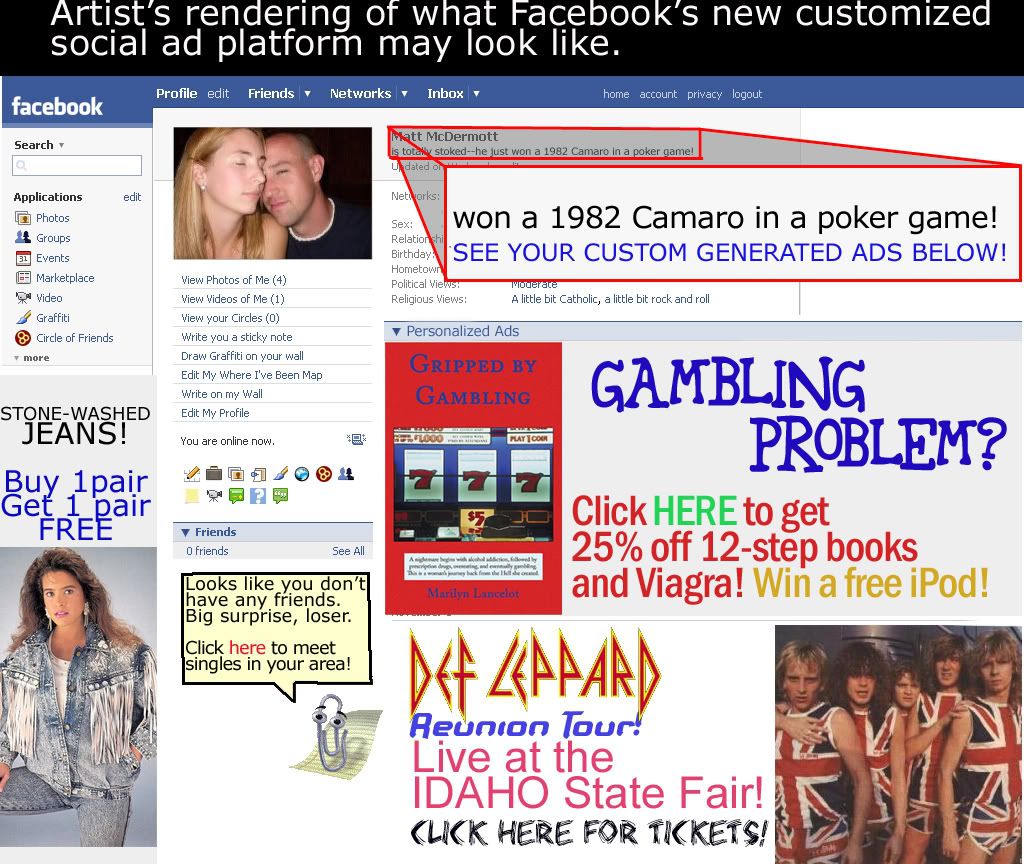
Social Ads? Okay, so the name is partially fluff. What ads aren't social? But naming conventions aside, Facebook's announcement of its new consumer-centric advertising model constitutes a major shift in the way messages can be delivered in the digital domain. I know, you’re probably thinking, “But how does it work, Jason? I didn't read any of the other 90,000,000 articles written on this same topic.”

Here's the basic concept. When a Facebook user visits a brand's Facebook page or external website in some cases, they'll be able to share and promote their interaction with the brand with friends. This user-initiated recommendation is then matched by Facebook with an advertisement created by the advertisers. Advertisers create these ads based on and directed towards demographic information obtained directly from traits Facebook users voluntarily post to their profiles, such as age, interests, hobbies, political affiliations, etc. Thus highly focused ads are directed "socially", from person to person, instead of from unknown external sources.

WTF!? (What the Facebook!?) Exactly. If it works it could be a watershed moment for Facebook and marketing in general. And that's really the question. Can it work?

(Click here to see englarged picture)

As I see it, there are a few hurdles, but all of them are surmountable. First, will users recommend products to friends? On the surface this may seem unlikely. But people do this all the time. In the real world it's known as "word of mouth" advertising. In the online world, I suspect brands will need to offer enticements to get the ball rolling, or make the recommendation process feel more like a game, but I don't think it will take much. People love to make their opinions known and share with friends where their minds are. Twitter is a perfect example of the level of social minutia people are willing to send and consume.

Until recently the assumption was that consumers didn't really care enough about products to visit their websites. Consuming the product was one thing, but who wants to read a website about their favorite brand of toothpaste? But a study conducted by ComScore throws strong doubt on this assumption. According to the study, "a majority of U.S. consumers visited at least one package-goods website during the three months ended in April, with search driving a substantial proportion of those visits."* And these visits were primarily initiated by the consumer. " Only 40% of searchers and 47% of non-searchers said they went to brand sites to seek promotional deals, compared to 73% and 58% respectively who went there seeking information and help."*

But is the demographic information advertisers are using to create their targeted messages reliable? After all, users voluntarily add this information, and are under no duress to make it accurate. Who hasn't fudged the truth a bit (or a lot, depending on how low your baseline is) in favor of themselves when creating an online persona. It's like online dating. Make yourself seem as attractive to other people as possible. They'll have plenty of time to be disappointed when they finally meet you.Ultimately, I think this is a non-starter. Yes, people lie. But I think mild exaggeration and understatement are the worst evils most people include in their online existence. After all, most online social linking (outside of dating) is between offline friends, already known entities. You can't get away with much when your friends are policing you. Plus, the point of online social linking is to find and interact with like-minded others, and lying defeats this.Of course, even outright lies make for useful information. If someone feels strongly enough about a particular idea, product or company to lie about it on their Facebook profile, they'll be interested in forwarding even incorrectly matched advertising messages to their friends and family.

Ultimately, I think socially distributed advertising's benefits will outweigh the detractors. Advertising sent within social interactions feels less like advertising and more like friendly recommendations, akin almost to viral marketing videos on YouTube. At least that's what Facebook and their prospective advertisers will be banking on. And I for one think it's great and highly recommend it!

*Source: Advertising Age - October 23, 2007 - "Study Finds Large Audience Online for Package-Goods Brands", Jack Neff (Look! I footnoted!)

Jason Bloom, Senior Avid Editor

Read more...
Facebook's Social Ads GambleSocialTwist Tell-a-Friend

11 July, 2007

Viral Video?

Yesterday I came across a video at Break.com, a favorite site of mine for watching foreign commercials, funny videos, and guys ages 10-30 hurting themselves. Thanks to Break, I firmly believe skateboarding is the most dangerous sport in the world.

But in this video, “Dog Goes Crazy After Drinking Slurpee,” a dog drinks a Slurpee, shows its blue tongue, walks backwards, then jumps through a wooden fence, causing the fence to collapse. Something looked fishy. Not only can most dogs not walk backwards, but even fewer can leap three feet in the air and propel themselves through a fence. Also, it reminded me of the Toyota Tundra commercials where the Tundra is in the background, and the focus is on the people in the foreground. Then the Tundra is pushed off a cliff or is struck by a meteor and survives. Yay Tundra! What begins as a mildly interesting commercial ends with a big bang.

So I went back and watched the video again. They say “Slurpee” at the very beginning. The Slurpee logo is prominently displayed on the side of one cup for 3-4 seconds. And the cups are an easily visible pink or purple. The only colors that bright in the video are the blue Slurpee in the dog bowl and the dog’s blue tongue.


Then I searched YouTube and, sure enough, found the same video titled, “Watch the Mental Dog!” However, this video had a tag at the end for a contest run by, http://www.slurpee.com.au/, Australia’s Slurpee website. Aha!


Viewers of both videos noted the video was funny, that is was cruel to give the dog so much sugar or that the video was obviously an ad. So I typed the words “slurpee” and “dog” into the youtube search engine and came up with a few similar hits of different dogs drinking Slurpees, always with the Slurpee logo prominently displayed.

If makers of the video hadn’t gone through so much trouble to force in the Slurpee image or to make the outcome of the video so over-the-top, I probably would have been fooled. Of course, “Dog Drinking Slurpee” isn’t nearly as interesting as “Insane Slurpee Dog Jumps Through Fence.” I should also note the description for the original YouTube video didn’t state the dog jumped through the fence. That’s the surprise. That video, posted in November, had nearly 7,000 hits. The Break video, on the other hand, did note that the dog jumped through the fence, so I clicked.

The best viral videos are subtle, not intrusive, so viewers can’t sniff out the advertisement. When you can get a viewer interested in a product, but keep them from realizing they’re being advertised to, 1) you get around the cynicism some people have towards advertising—the “I’m not gonna buy that just because you want me to” attitude, and 2) the customer now thinks they know more than the other guy, and wants to be able to say they were one of the first to get in on the next big thing that the not-so-smart consumer didn’t see.

Subtle product placement or product imbedding also does this very effectively—an athlete drinking a hip new beverage on the sideline, a celebrity flaunting this year’s hot new item while “hanging out” at some media-rich event, or a Red Bull refrigerator in the liquor store on an episode of 24. Jack Bauer must be tired. It’s almost 10 PM. I’m tired too.

Look in the background, see what advertisements you might be missing. But makers of this video were a little too by-the-advertising-book, and thus were easier to catch, by me and by many advertising-savvy Web surfers. So good try, Slurpee, but we figured you out. Looks like Slurpee lost this one.

Or did they? As of yesterday, the Break video, posted this Sunday, had almost 400,000 hits. Oh, one more note. Today is July, 11—7-11. Hm. We figured you out, Slurpee, but not before you got your advertising message out to nearly half a million people. Slurpee, you win this round.

-Captain Awesome, Project Specialist

Read more...
Viral Video?SocialTwist Tell-a-Friend
The Renegade Agency Confessional - Blogged

  © Blogger templates The Professional Template by Ourblogtemplates.com 2008

Back to TOP