Showing posts with label jason bloom. Show all posts

17 February, 2009

What's in a name: The etymology of advertising


Today's a bit of a slow day in Editsburgh, so for fun and distraction I went looking for the etymology of "advertise." Here's a snippet from www.etymonline.com.

c.1430, "to take notice of," from M.Fr. advertiss-, prp. stem of a(d)vertir "to warn," from L. advertere "turn toward," from ad- "toward" + vertere "to turn" see versus). Original sense remains in advert "to give attention to."

The important bit here, I think, is the root meaning. Ad Vertere, "To turn toward." What I'm struck with is how dated a definition that is. It smacks of hand-holding and weak-kneed pleas for attention, and springs from a time when advertising listed features and benefits. Simple presentations intended to bridge the gap between a consumer's need and an advertiser's solution. It's far too passive to describe the realities of our business in the 21st century. We need a strong, active word.

Something like "crevantising". Born from the Latin creare, meaning "to make, produce," and vant, meaning "to lack, wanting", crevantising is a nearly perfect embodiment of our industry. We no longer bring consumers to our clients' products, passively filling existing needs. We create needs. We can sell products that do one thing by extolling wholly unrelated, and largely fabricated benefits. We sell image, not products. It's a major distinction, because the shift marks our transition from childhood into adulthood. We no longer fit the peg to the hole. We drill the hole to match the peg.

So maybe "makihooling" is a better word. Derived from German and Dutch, it's a simple statement of what we do. We make holes. Holes for our clients' products to sell through. Holes in the claims of our clients' competitors. We find the walls that keep our clients from being successful, the walls that keep consumers from listening, and drill the necessary holes to bring those walls down. And there are a lot of walls.

One major barrior is the media rich, message heavy environment we work in, which suggests another term. "Forlocising," from the Latin fortia, "strong, force", and the Old German locian, "to gaze, to see". We actively force viewers to look at our messages. Our clients are forlocizers, by choice and by necessity. Not only do they want to bring their message to as many eyes as possible, as often as possible, they are forced to do it in an already massively populated landscape. As forlocising professionals, it's our job to help our clients cut through the din.

Take your pick. Crevantising. Makihooling. Forlocising. All strong, dynamic words for an industry to match.

Yes, for fun...what do you do?


Read more...
What's in a name: The etymology of advertisingSocialTwist Tell-a-Friend

06 March, 2008

Zen and the Art of Motorcycle Advertisement


Above, ads created for Harley-Davidson by Carmichael Lynch out of Minneapolis: very choice, top notch creative in my opinion. A bold presentation of the sense of individuality that's a trademark of the Harley-Davidson brand. See the individual in the motorcycle.

The time and care that was clearly invested in creating these images, and the method employed, reminds me of another art form. Tibetan sand painting.
In case you're unfamiliar, Zen monks spend hours upon hours intricately pouring colored sands onto the ground to create beautiful imagery. Upon completion, the doors to the temple are flung open and the wind erases the images forever. It's an exercise of patience and humility, a downplaying of the ego and a strong demonstration of the impermanence of all things.
I'll grant that you'd be hard pressed to have a crankshaft assembly delicately float away on the breath of impermanence, but you can see the similarity nonetheless. Once all those motorcycle parts have been cleaned up, installed, and driven off to have half-naked, drunken motorcycle groupies cavort on them at rock concerts and biker rallies, the original assemblage image is gone. Yes, unlike the sand paintings, we have a photograph to remember it, but that brings me to my ultimate point.

The Harley ads are just one small part of a huge body of creative work our industry generates on a regular basis, work that, while permanent in form, is just as ephemeral in long term viewership as our monks' sand creations.

It's inevitable. Every great billboard, TV spot or print ad is eventually replaced. And this process repeats again and again, ad infinitum (no pun intended). With media consumption growing exponentially, this turnover will occur at an ever accelerating pace in the future. So we, as creatives, deliver painstakingly developed, beautifully rendered, multi-faceted campaigns to our clients, and in a month the winds of consumption blow them into obscurity.

Surprisingly, I'm not complaining. There's something wonderful behind sand paintings. They say, "Release your attachments and just let beauty be. Yes, you created something glorious, but who are you? What does your minor achievement mean against the backdrop of a universe so staggeringly big it's impossible to imagine it? Your work is beautiful, and now it's gone."

I originally intended this article to be something of a rant against the mad rush to replace. But the more I write, the more I'm changing my mind. Ultimately, I think it's a very healthy way to think about what we do. We're not Van Gogh or Da Vinci, creating work that will last for centuries (and one could argue that, on a cosmic time scale, even their work is fleeting). We create for the Now. And we have the opportunity to keep doing it over and over again. So I say, fling open the doors, wipe the slate clean, and get to work!

Jason Bloom, Senior Avid Editor

Read more...
Zen and the Art of Motorcycle AdvertisementSocialTwist Tell-a-Friend

22 January, 2008

The Shroud of Vytorin

I don't intend this article to be an indictment of the drug industry. Lord knows they're doing a fine enough job of making themselves look bad.

The fact Merck & Co. sat for a year on the knowledge that claims they were making about Vytorin--their cholesterol-reducing drug--were wholly untrue isn't unexpected or even surprising. Remember Vioxx? Drug companies spend huge sums of money on R&D for new drugs. Once investment has exceeded a certain critical mass, the drug companies are loathe to let something like the truth interfere with the investment-to-profit conversion process.

Right. Drug companies bad. Established. But what responsibility, if any, do we, the crafters of the demon's message, bear? A recent Advertising Age article, "Vytorin Ad Shame Taints Entire Marketing Industry" by Rich Thomaselli is flavored with the idea that, in the public's eye, we the marketers stink a bit, having rolled in the drug industry's poo.

I have to disagree with this assertion. I've researched this extensively (I beg you some latitude on the meaning of "extensively"), and I've found that our function is transparent to consumers. The messages we bring to consumers aren't perceived to have come through some third party. They seem to be the advertiser speaking directly to the consumer. Nobody blames the telephone company when bad news comes to them over the wire. Or, more to the point, nobody would claim that ABC bears any responsibility for airing Vytorin's bogus claims.

Marketers, like television stations, are messaging enablers. The public knows we can only work with what we're given. We're not investigative journalists. To have a genuine relationship with our clients, we must trust that they are, at least, being forthright with us concerning their claims. After all, for every story of drug company misadventure, there's a story where they play the role of hero.

I'm not worried. We, as a transparent communication enabler, get to sit on both sides of the fence. Merck has a lot of explaining and apologizing to do. And we ad folks will be there to craft the message.


For right now, though, expect everyone to see Vytorin in a different light.


Jason Bloom, Senior Avid Editor

Read more...
The Shroud of VytorinSocialTwist Tell-a-Friend

13 December, 2007

Guerilla Marketing Gets Down and Dirty

You'd think by now I'd be used to the adulation, but I still get a lump in my throat each and every time I read one of the lovely letters you out there send me. Keep them coming. Along with your questions. I received this one a few days ago:


Dear Jason,

I'm a creative-type person at a very powerful ad agency in a city in the US. Lately I've become concerned that advertising, as it is classically framed, is in fact, dead. Or dying, at least. Yes, I know. How boorishly, post-modern, generic, Nihilist of me. But here's my issue: Media glut. The numbers we call "people" who consume our messages are bombarded from every conceivable medium almost constantly. I'm afraid that getting any of these "people" to sort our clients' messages out of the morass, through standard channels at least, is like a Paramecium reading a "Where's Waldo?" book. Help!!

Nietzsche Marketer


Dear Nietzche Marketer,

It's definitely not dead. I poked it, and it was still breathing. But yes, normal advertising channels are becoming more and more like screaming into a windstorm. Or worse, like screaming into a vacuum. Case in point is the continuing erosion of the :30 TV spot by DVR and similar technologies. So what's a creative-type advertising monkey to do? Go guerilla. Ditch the standard channels. Find a new hill to climb--one where no one is standing--and fling your poo in the surety that gravity and a lack of obstacles will deliver your message into the faces and minds of the numbers below.

The folks over at
Street Advertising Services have developed a pretty novel approach to "cutting through the muck." They do it by actually cutting through the muck...with high pressure water cleaning. They call it "Reverse Graffiti." It's like the "Wash Me" messages we've all seen scrawled out of the dirt on the backs of garbage trucks (and my Jeep, for that matter. Punk kids!). For an undisclosed fee, SAS will take an advertiser's message, convert it to a stencil, and then clean it into dirty pavement, walls, and buildings. Any soiled surface becomes a potential messaging spot. And, unlike standard graffiti, this isn't illegal. They're just cleaning the sidewalk, or parts of it at least.

Another sort of "street" advertising is performance art. Create an event, or happening, real or not, that will catch people's eyes. Here are a few examples that, assuming the Infinite Universes theory is correct, could surely happen...one day. Imagine:

- General Mills, in a bid to increase awareness of its Cookie Crisp brand cereal, hires actors to play Keystone Cop characters, chasing the Cookie Crook around Times Square to reclaim a stolen breakfast.

- A California wedding planner stages a lavish mock wedding beside the Golden Gate Bridge with signs everywhere saying, "Wedding Crashers Welcome". In a co-branding effort, New Line Cinema sponsors the dinner buffet.

- Yukon Gold Bank and Trust fakes a robbery in one of their branches, complete with phony police outside, in an effort to compete with larger banks and gain some relatively free exposure; the media doesn't know the robbery is a fake, although the local police are informed ahead of time.

The moral here is this: When there are too many others in your tree, find another tree. All you really need to do to ensure your clients' messages are heard is exercise that creativity pent up in your little simian brain and guerilla market your way to advertising success!

Love Always,

Jason Bloom, Senior Avid Editor


Read more...
Guerilla Marketing Gets Down and DirtySocialTwist Tell-a-Friend

09 November, 2007

Facebook's Social Ads Gamble

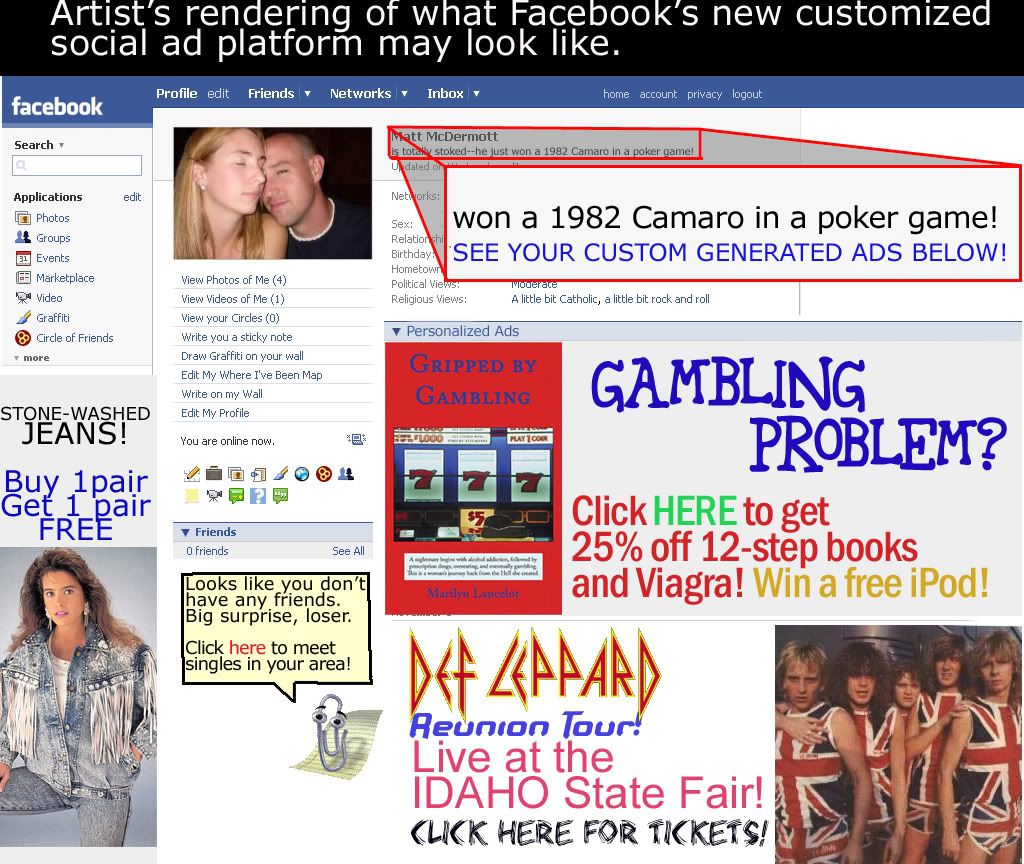
Social Ads? Okay, so the name is partially fluff. What ads aren't social? But naming conventions aside, Facebook's announcement of its new consumer-centric advertising model constitutes a major shift in the way messages can be delivered in the digital domain. I know, you’re probably thinking, “But how does it work, Jason? I didn't read any of the other 90,000,000 articles written on this same topic.”

Here's the basic concept. When a Facebook user visits a brand's Facebook page or external website in some cases, they'll be able to share and promote their interaction with the brand with friends. This user-initiated recommendation is then matched by Facebook with an advertisement created by the advertisers. Advertisers create these ads based on and directed towards demographic information obtained directly from traits Facebook users voluntarily post to their profiles, such as age, interests, hobbies, political affiliations, etc. Thus highly focused ads are directed "socially", from person to person, instead of from unknown external sources.

WTF!? (What the Facebook!?) Exactly. If it works it could be a watershed moment for Facebook and marketing in general. And that's really the question. Can it work?

(Click here to see englarged picture)

As I see it, there are a few hurdles, but all of them are surmountable. First, will users recommend products to friends? On the surface this may seem unlikely. But people do this all the time. In the real world it's known as "word of mouth" advertising. In the online world, I suspect brands will need to offer enticements to get the ball rolling, or make the recommendation process feel more like a game, but I don't think it will take much. People love to make their opinions known and share with friends where their minds are. Twitter is a perfect example of the level of social minutia people are willing to send and consume.

Until recently the assumption was that consumers didn't really care enough about products to visit their websites. Consuming the product was one thing, but who wants to read a website about their favorite brand of toothpaste? But a study conducted by ComScore throws strong doubt on this assumption. According to the study, "a majority of U.S. consumers visited at least one package-goods website during the three months ended in April, with search driving a substantial proportion of those visits."* And these visits were primarily initiated by the consumer. " Only 40% of searchers and 47% of non-searchers said they went to brand sites to seek promotional deals, compared to 73% and 58% respectively who went there seeking information and help."*

But is the demographic information advertisers are using to create their targeted messages reliable? After all, users voluntarily add this information, and are under no duress to make it accurate. Who hasn't fudged the truth a bit (or a lot, depending on how low your baseline is) in favor of themselves when creating an online persona. It's like online dating. Make yourself seem as attractive to other people as possible. They'll have plenty of time to be disappointed when they finally meet you.Ultimately, I think this is a non-starter. Yes, people lie. But I think mild exaggeration and understatement are the worst evils most people include in their online existence. After all, most online social linking (outside of dating) is between offline friends, already known entities. You can't get away with much when your friends are policing you. Plus, the point of online social linking is to find and interact with like-minded others, and lying defeats this.Of course, even outright lies make for useful information. If someone feels strongly enough about a particular idea, product or company to lie about it on their Facebook profile, they'll be interested in forwarding even incorrectly matched advertising messages to their friends and family.

Ultimately, I think socially distributed advertising's benefits will outweigh the detractors. Advertising sent within social interactions feels less like advertising and more like friendly recommendations, akin almost to viral marketing videos on YouTube. At least that's what Facebook and their prospective advertisers will be banking on. And I for one think it's great and highly recommend it!

*Source: Advertising Age - October 23, 2007 - "Study Finds Large Audience Online for Package-Goods Brands", Jack Neff (Look! I footnoted!)

Jason Bloom, Senior Avid Editor

Read more...
Facebook's Social Ads GambleSocialTwist Tell-a-Friend

18 July, 2007

The Science Behind Co-Branding: A Satire

Elmo dolls at Build-a-Bear? Incredible Hulk Popsicles? Olson Twins Toothpaste?? Does this seem like a heaping dose of insanity to you? Well it's not, Pope Urban. It's called "co-branding." Co-branding is prevalent in all sectors of the marketplace, from Pillsbury cookies featuring M&Ms brand candies to Starbucks coffee service on United Airlines flights. But nowhere is it more ubiquitous than in the entertainment industry.

Entertainment properties from movies, television, and music are used to sell an enormous variety of products, from shoe polish to breakfast cereals. These pairings often make little sense on the surface, beyond being a convenient way to sell hair gel while advertising your latest video game. But I've looked a little deeper and found that, In truth, there is a strong ethic amongst researchers and marketers alike to create co-branded products that far exceed the standard single brand equivalents.

As a video editor, I take scientific validity issues in co-branded marketing campaigns very seriously. So I launched a rigorous, multi-phased, cross-media marketing analysis that lasted hours and took minutes to complete. Here are a few examples of the science behind co-branding.


Why has everything gone Shrek? It's not because he's adorable, funny or a highly bankable commodity. It's because he's green. Remember how popular Kermit was in the 70s, or Yoda in the early 80s?. In a recent double-blind study conducted in Massachusetts, students at the Perkins School for the Blind were more likely to say they preferred foods colored green over other colors even though the students have no concept of green, or colors in general. And this favoritism jumped 540 percent when the subjects were administered powerful electric shocks when touching the non-green food products! Interestingly, 540 nanometers is the frequency for green light. Coincidence?

Congress doesn't think so. Recent legislation requires automakers to build greener cars by 2012. Why green? Certain harmonics in the paint cut down on drag, making the cars more energy efficient. In fact, green energy initiatives are everywhere, due to the considerable power in green's 540 nanometer wavelength. But color is only one factor to consider when creating a superior product.

Another study conducted by field mice outside of Denver found a strong correlation between the shape of molded oat cereals and their nutritional efficacy. The study found that the web shape used in Spiderman Brand Cereal had the highest surface area to mass ratio of all breakfast cereals, causing a nearly instantaneous digestion and absorption of all 12 vitamins and minerals included as part of your complete breakfast. Cheerios? It ranked 54th, six spots lower than Lucky Charms and 12 spots lower than topsoil.

And what about that Olson Twins toothpaste? Two words: super spittle. The gorgeous duo owe their flawless smiles to a minor genetic anomaly that gives their saliva 10 times the cleansing power of any known substance. Toothpaste is only the logical jumping-off point. Soon Mary Kate and Ashley's drool will replace an entire generation of outmoded cleaning products.

I think I've made my point. The next time you're pondering a co-branded entertainment venture please don't let ridiculous mismatches in products and brands stop you. Just make sure the science is sound and everything else will take care of itself. Oh, and look for Jason Bloom brand spray cheese and drain cleaner, coming to a supermarket near you.

--Jason Bloom, Senior Avid Editor

Read more...
The Science Behind Co-Branding: A SatireSocialTwist Tell-a-Friend

29 June, 2007

Jason Bloom, Senior Avid Editor

"Woah! Look ad that 'a crasy pigture. Yu ahr so a' free kee man!" That was lifted from a recent voicemail from an unidentified fan located somewhere deep in eastern Europe. I'm not sure why, but I've developed a large cult following amongst residents of the former Soviet Bloc. I get four and five messages a day, usually unintelligible except for the obvious tone of rapture and reverence in their voice.

Why? Got me. I'm just the senior editor here at Renegade. Sure I've been an employee for twelve years and am the third tenured at the company, but that doesn't warrant constant emails in Estonian usually translating to, "I would sell my children into slavery just for the knowledge that you deigned to read my pitiful bleating of a message." I'm not even that talented. There are at least three other people in the world more talented than I am.

I don't know. I guess it's my chiseled good looks, my legendary stamina, and my fabled use of "The Persian Butterfly" Technique. Whatever it is, I'm just humbled that so many people around the world want to be near me. It's quaint, really.

Read more...
Jason Bloom, Senior Avid EditorSocialTwist Tell-a-Friend
The Renegade Agency Confessional - Blogged

  © Blogger templates The Professional Template by Ourblogtemplates.com 2008

Back to TOP